Caffeinated Thoughts |

- SBA List Endorses Lt. Governor Rebecca Kleefisch in Wisconsin Recall Election
- The Original Liberty Tree
- Bella Santorum Has Been Hospitalized
- Via Dolorosa – Here Comes the Bride
- Sunday’s Coming
| SBA List Endorses Lt. Governor Rebecca Kleefisch in Wisconsin Recall Election Posted: 06 Apr 2012 09:30 AM PDT Washington, DC ─ Today the Susan B. Anthony List Candidate Fund, a national pro-life political action committee, announced its endorsement of Rebecca Kleefisch for Wisconsin Lieutenant Governor in the June 5 recall election.
"Lieutenant Governor Rebecca Kleefisch has proved she is a strong advocate for Life and the pro-life taxpayers of Wisconsin," said SBA List President Marjorie Dannenfelser. "Thanks to her leadership along with Governor Walker and the pro-life state legislature, Wisconsin has defunded Planned Parenthood of more than a million dollars."
Dannenfelser added, "We are proud to endorse her for reelection so that she may continue to serve the unborn and women of Wisconsin."
A reporter and news anchor for WISN-TV in Milwaukee, Kleefisch left television to focus on her family. A pro-life advocate, she was endorsed by Pro-Life Wisconsin, Wisconsin Right to Life, and Wisconsin Family PAC when she first ran for Lieutenant Governor in 2010. At the 2011 Faith and Freedom Coalition Conference, Lt. Governor Kleefisch joined Dannenfelser to discuss efforts to defund America's largest abortion provider, Planned Parenthood, and protect unborn children and women. Kleefisch stated, "We need to renew our commitment to protect the unborn. We need to renew our commitment to protect our most vulnerable citizens."
During the 2010 election cycle, SBA List spent $11 million and was involved in 90 races, 62 of which resulted in victories. Successes included: defeating 15 of 20 so-called “pro-life” Democrats who voted for abortion funding in the health care reform bill, increasing the number of pro-life women in the House by 70 percent, filling the void of pro-life women in the U.S. Senate, and increasing the number of pro-life women governors from one to four.
The Susan B. Anthony List is a nationwide network of more than 365,000 Americans dedicated to mobilizing, advancing, and representing pro-life women in politics. Its connected Candidate Fund increases the percentage of pro-life women in the political process. Link to this post!        |
| Posted: 06 Apr 2012 09:02 AM PDT The God of our fathers raised up Jesus whom you murdered by hanging on a tree. Him God has exalted to His right hand to be Prince and Savior, to give repentance to Israel and forgiveness of sins. – Acts 5:30-31, New King James Version The struggle for American independence wasn't something that happened overnight. Britain's 13 American colonies had been a cauldron of political discontent for some time. Americans balked at burdensome taxes and felt their needs were being ignored by parliament and the crown. The problem came to a boil in 1765, when the British Parliament passed the infamous Stamp Act, a tax on all legal documents, permits, commercial contracts, newspapers, pamphlets, and playing cards. The colonists saw this as a form of censorship. Since all printed materials from books to papers required the stamp, basically the British government was eliminating the freedom of the press and the freedom of speech. Only printed material approved by the Crown could be read. Then, as now, Americans hated what they considered to be an unfair tax. So, in true American fashion, they decided to hold demonstrations of protest. One of the most famous Stamp Act protests took place in Boston, Massachusetts, the birthplace of the American Revolution. On August 14, 1765, a group of men calling themselves the "Sons of Liberty" gathered in front of a grocery store at the corner of Essex Street and Orange Street, near Hanover Square. They staged their anti-tax demonstration under a large, old elm tree, and concluded it in fine American fashion by hanging two tax collectors in effigy. From that point forward, the elm at the corner of Essex and Orange became known as the "Liberty Tree." In following days, the Sons of Liberty gathered under the Liberty Tree to stage demonstrations against British tyranny. The tree became a rallying point for patriots and a symbol of the ongoing American struggle for freedom. Patriots hung banners and lanterns from its branches to symbolize unity to the cause of independence. Not surprisingly, British sympathizers and agents of the British government did not feel an affinity for the old elm tree. They scorned what it represented and mocked the colonists who met in its shade. British soldiers even tarred and feathered a patriot named Thomas Ditson, and then forced him to march in front of the tree. Finally, late in August 1775, a party of Loyalists – colonists who sided with the British government – chopped down the Liberty Tree and used it for firewood. The British and their sympathizers had done away with the Liberty Tree, but they couldn't kill what it represented. As the seeds of revolution spread across the colonies, more "Liberty Trees" were selected as gathering places for patriots. If a tree was not available, locals erected a pole around which to plot. As the idea of liberty took root, images of the tree appeared on colonial flags. After the Revolutionary War ended with American independence, the Liberty Tree lived on. It appeared in France in 1790 as a symbol of the revolution raging there. Five years later, another Liberty Tree was planted in Amsterdam. In 1798, Italians marked their freedom by establishing their own Liberty Tree. Even into the 20th century, the tradition of planting a tree to represent liberty endured. Today, a bronze plaque marks the location of the original Liberty Tree in Boston. While you may not be able to visit that site today, we can stop and consider the price paid to win the freedoms we celebrate. The Liberty Tree also reminds Christians that political freedom means little if we are spiritually enslaved. (Spiritual enslavement leads to political enslavement.) However, spiritual liberty didn't originate under a Boston elm tree: Jesus Christ won it for us on a tree outside Jerusalem almost two millennia ago. The tree was cut down to make a cross for the Son of God. We don't know where the timbers came from. We can't say, "X marks the spot," concerning where the wood originated, but Christians have traditionally referred to the cross as a tree on which Jesus was crucified. On that "old rugged cross" our Lord was pinned to the timber by nails. But not just nails, for His love for man held Him there. Criminals were crucified along this busy road as a deterrent to crime and a reminder to criminals of what happened to those who broke the law. The Romans were cruel taskmasters, and they used crucifixion as the most violent form of punishment and eventual death ever known to man. The tree we know as the cross was God's Stamp Act, where His Son was imprinted with our sin. He who knew no sin became sin for us. He took our sin so that we could be set free from the tyranny of sin and death. He died there, so we might live. Since that time, many have ridiculed the cross. Others have tried to erase its memory. But despite their efforts, that tree and the freedom it represents has spread around the globe. It lives on in the hearts of millions today. That tree—that cross—became our original Liberty Tree. It is where God met man in his greatest need. He offered forgiveness and grace through His death. There is no plaque, no national memorial there, but millions upon millions have traveled to the Holy Land for the last two thousand years to remember it was there that Christ paid for our sin. Jesus was not a famous general; He was a humble carpenter and a servant. Jesus is not the leader of a religion, Jesus knows nothing of religion. Jesus came to establish relationships and to restore fellowship with man. Religion is man reaching up to God to try to appease Him and gain His approval. Christianity is God reaching down to man. Jesus did for us what we could never do for ourselves. As we approach the celebration of the resurrection, it's not about eggs, bunnies, and candy. It's about eternal love, shed blood, and a cross. Like America's Liberty Tree at Essex & Orange, The most famous tree in the history of the world doesn't exist any longer. It served its purpose. It held the body of the perfect Son of God, the creator of everything on this planet. It's gone, but HE LIVES.
Link to this post!      |
| Bella Santorum Has Been Hospitalized Posted: 06 Apr 2012 09:00 AM PDT Verona, PA – The Rick Santorum for President campaign has issued the following statement on the health of Isabella Santorum. Hogan Gidley, National Communications Director, said: “Rick and his wife Karen have taken their daughter Bella to the hospital. The family requests prayers and privacy as Bella works her way to recovery.” Editor's note: Bella has a genetic disorder called Trisomy 18. Most children with this condition do not live past their first birthday. Bella was hospitalized back in January with Pneumonia and experienced what Rick Santorum described as a miraculous recovery. Please be in prayer for Bella. We'll update as we learn more. Link to this post!      |
| Via Dolorosa – Here Comes the Bride Posted: 06 Apr 2012 07:54 AM PDT 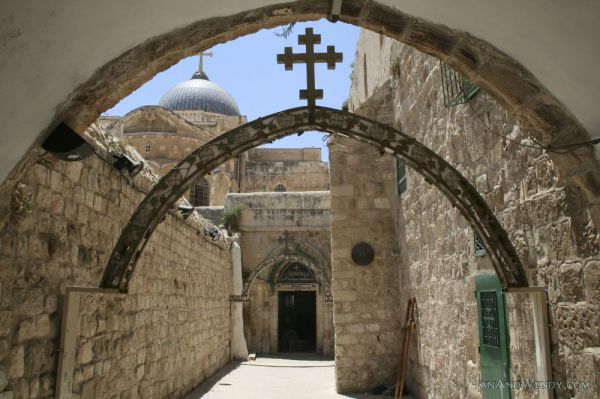 Via Dolorosa in Jerusalem Via Dolorosa. Spanish for "way of suffering". Perhaps others of you have found yourselves in a place of suffering these past months. Either through illness, divorce, financial hardships or just the pain of a relationship gone awry. I have personally been through a season of rejection and pain so deep I despaired of ever emerging whole. Throughout this time, the Lord has repeatedly brought me to different views of His suffering and His character. The most recent, was a powerful image of Him carrying His cross through the Via Dolorosa, a narrow street that winds through Jerusalem and ends at the hill named Golgotha. He spent every last ounce of His strength on this "Holy Must". To accomplish the will of His father, on behalf of the very ones who were now rejecting and deriding Him as He made His way to Calvary. I cannot express how this picture of the lamb going to slaughter, not opening His mouth against those who persecuted and murdered Him, affects me. To say that I can comprehend His sacrifice would be heresy. But as I have laid down my life for another, and received grief in exchange, I have begun to appreciate the cross in a new way. I think of Peter, who being prepared for crucifixion, declared, "I'm not worthy to be crucified in the same manner as my Lord" so they hung him upside down. I'm speechless. I would be saying, "I don't want to be worthy to be crucified in any manner at all!" I despise the pain and the shame. I shrink back at loving others to my own hurt. I find it nearly impossible to keep my mouth shut and allow Him to be my defense, knowing that my reward is AFTER the cross. And that it's actually going to be what the other person receives, and not myself. I'm attempting, and rather poorly, to compare the Via Dolorosa to the work of the cross in our relationships with others. I think we glamorize sacrifice in our minds and when it comes to choosing to love others, in word and deed, if it requires that we let go of self-justification and embrace a death to our flesh, we balk. And whatever glory may have been brought forth in that circumstance is aborted. To me, this is really about the work of unity He is doing in the church. It will not be complete unless we learn to lay down our lives for one another. How do we do this you ask? Perhaps it would be better to ask someone else. It is by His grace alone that I am squeezed through this narrow way of suffering to come out the other side in each situation proclaiming, "not my way, but Yours Lord". For my flesh cries out in anguish. And as my unhealed wounds are exposed, I want to run and hide. But there is nowhere to run. The way is too narrow and my enemies surround me. I have a 'Holy Must' to make it to that hill and to at last lay my burdens down, declaring them finished. Burdens of pride, arrogance, self-seeking, self-defense, self-glorying, fear and distrust. For the joy set before us, let us run the race with diligence, counting Him as faithful who made the promise. Three days in the tomb and then we shall be raised up with Him. Transformed into His image. No longer hindered by the temporal things of earth, but radiant with the Light that at last overcomes the darkness. Link to this post!      |
| Posted: 06 Apr 2012 05:30 AM PDT The event that Christians around the world commemorate today – the crucifixion of Jesus Christ – would be meaningless if it were not for Sunday. The tomb would still be sealed. Death would still hold its grip over us. We would not have forgiveness of sin. The Apostle Paul knew what was at stake when he wrote to the Corinthian Church.
Praise God though Sunday's coming! The tomb could not hold him, and while he suffered and died – even death could not conquer Him. I wanted to share the video above that features S.M. Lockridge's famous sermon, "It's Friday, But Sunday's Coming" with clips from the movie The Passion of the Christ. Link to this post!      |


| You are subscribed to email updates from Caffeinated Thoughts To stop receiving these emails, you may unsubscribe now. | Email delivery powered by Google |
| Google Inc., 20 West Kinzie, Chicago IL USA 60610 | |

In case you are looking into generating money from your traffic with popunder advertisments - you can embed one of the most established companies: Pop Cash.
RăspundețiȘtergere