Caffeinated Thoughts |

- Our President: Elected or Selected?
- Louisiana Association of Educators Threaten Voucher Schools With Lawsuit
- Krugman Is Wrong Again: Slash Spending Now!
| Our President: Elected or Selected? Posted: 28 Jul 2012 12:50 AM PDT The following is an excerpt from my book, With Christ in the Voting Booth (6th in a series).
It was 1971. Over 150,000 hamstrung American soldiers continued to battle bravely against the Communists of North Vietnam and the Viet Cong, while many of their comrades returned home and faced humiliation from some of their own countrymen. Instead of getting a pat on the back and a warm handshake, they got the cold shoulder and spit in the eye. Deserving merry welcome-home celebrations, they found themselves denounced at the airport as traitors and baby-killers. In the spring of that year, God would use the keen ears of a lonely captive in the Hanoi Hilton[1] and the mumblemouth of a future Senator from Boston as agents to carry out His plan to keep a Republican President in the White House.[2] The dispassionate voice blaring through the PA system at the Vietnamese concentration camp seemed unreal to Prisoner-of-War, Navy Commander Paul Galanti. What he heard was purported to be a former Navy Lieutenant, who had returned home from Vietnam and was now speaking to Congress.[3] Galanti had spent about 5 years as a POW and wished he too could go and build a happy and peaceful home with the woman who had become his wife shortly before he was taken captive by the North Vietnamese. Now he was forced to listen to this prevaricator on a loudspeaker telling made-up stories about American troops, suggesting they had routinely done awful and unthinkable things, from bombing villages of innocent civilians to shooting at them like sport. He was portraying his compadres as vicious and sadistic. In short, the man's testimony was being broadcast into Galanti's ears to demoralize him and his fellow POWs by getting them to believe they were serving an evil regime or to confess to war crimes they did not commit. The gist of what Galanti heard that day would stay in the forefront of his thinking, even after his joyous return home upon his release in 1973. But one seemingly insignificant detail from that speech would be buried in his memory, only to return on the day of God's choosing thirty years later. In 2003, Galanti was invited to a meeting of veterans to discuss the possible candidacy of Senator John Kerry, a Democrat from Massachusetts, who was seeking to oust President George W. Bush. Someone at the meeting offered to play a few audio clips from Kerry's past anti-war days, including Kerry's Winter Soldier testimony before Congress. Galanti had understood there were many hearings, many testimonies and many false claims being made against American soldiers while he was a POW, so he took no special note of Kerry's involvement. There was no reason for him to think this was the anti-war speaker he heard back when he was a prisoner, until the following clip was played:
Kerry had mispronounced the name of that barbarian as "jen-jus" Khan rather than "geng-us". When Galanti heard this tape played, the memories of his mental torture flooded back. He immediately knew this was the man whose voice was used to torment him and his fellow soldiers. He had never heard anyone else pronounce that name in that way. Galanti immediately volunteered to do anything he could to oppose Kerry's candidacy. Knowing nothing else about him, it was enough. This wasn't just any anti-war protester. This was THE traitor, as Galanti saw it. This was personal. After this meeting, Paul Galanti and others formed a 527 organization called Swift Boat Veterans for Truth. They would eventually run millions of dollars' worth of television and radio ads, including one ad which featured Galanti. These helped ignite opposition to Kerry and kept him on the defensive the rest of his campaign. It blunted the effect of a decorated veteran's opposition to the Iraq War which might have been a winning issue for him otherwise (just as the American people were starting to grow weary of the war). Instead, questions about Kerry's anti-war protests and the legitimacy of his medals were the issues that dominated the campaign. I am not arguing for the truth or falsity of the ad campaigns,[5] rather, I am pointing out how one mispronounced word may have cost Kerry the election. Certainly the Swift Boat campaign made a profound impact:
Senator John Kerry of Massachusetts wanted to be president of the United States. God opposed it, so it didn't happen. I've got a long list of people God didn't want to be president. Let's start with Mike Huckabee. I don't know why God didn't want one of His own preachers to be president in 2008; I certainly did. The Lord raised up Barack Obama to be president instead. It was not because I had a vision from God or a visit from angels that I can say that God selected Obama, I got it from the Bible. No, I didn't crack the code (there is no code). I don't have a special set of magical reading glasses, nor did I twist some difficult-to-understand prophecy to fit my own preconceived notions. I did what any political prognosticator could do: I read and applied a simple passage of Scripture. Here it is: "He removeth kings, and setteth up kings" (Daniel 2:21). [1] This was the name given in irony to a prison camp holding captured U.S. military personnel, which was nothing like a luxury hotel. Our enemies had frequently used torture and inhumane treatment to brutalize Paul Galanti, John McCain and many, many others captured during the war. [2] Nixon would be reelected the next year, but that is not who I am referring to.        |
| Louisiana Association of Educators Threaten Voucher Schools With Lawsuit Posted: 27 Jul 2012 01:30 PM PDT 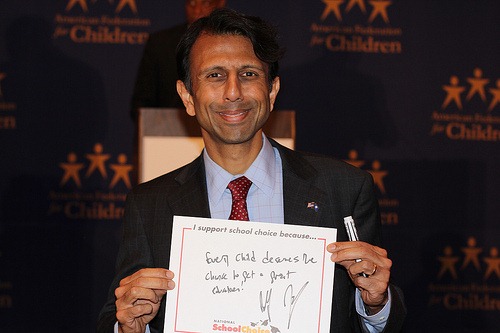 Louisiana Governor Bobby Jindal shows his support of school choice by SchoolChoiceWeek via Flickr The teachers' union in Louisiana, the Louisiana Association of Educators, are now sending demand letters from their lawyers to private schools in the state's new voucher program warning them to pull out or they could be sued. You can see the letter below, the name of the school has been redacted: The Baton Rouge law firm, Blackwell & Associates, on retainer from the Louisiana Association of Educators, threatens to initiate litigation against individual schools if they do not pledge—in writing—by 4 p.m. local time today to cease participation in the Student Scholarships for Educational Excellence (SSEE) program. This letter came the day after the Louisiana Department of Education announced announced the extension of 5,637 scholarship offers to students to participate in the program this fall—just a portion of the 10,300 applications the Department received. This letter stands in stark contrast to the parental demands seen in Louisiana. TheHayride.com points out that this could have a chilling effect to small schools participating in the program:
The American Federation for Children, a nationally known advocate for school choice, called the letter a bully tactic by the Louisiana Association of Educators. In a statement released yesterday, Kevin P. Chavous a senior advisor for AFC said, "It's despicable that adults would use the threat of legal action to stop schools from accepting students who desperately want a better education, thereby squashing their dreams and those of their parents. Even by standards of the typical special interest bullying tactics, this is an unbelievably demeaning and insulting action that aims ultimately to hurt the futures of thousands of children." Of the initial SSEE voucher offers 84% of students attended a school rated at the "D" or "F" by the Louisiana Department of Education. This letter was also sent after new accountability measures, strengthening the program, were approved by the Louisiana Board of Elementary and Secondary Education. Also the state appeals court yesterday denied an attempt to block the voucher program from going forward. Chavous, a former D.C. City Council member who has also worked for years to reform education in Louisiana, reiterated that the recent LAE move was unprecedented in its callousness. "Personal power should never, ever be put ahead of the best interest of disadvantaged children," Chavous said. "These union leaders have no shame." The Pelican Post quotes Clint Bolick, the Vice President for Litigation at the Goldwater Institute, noted that this move by the teachers' union is unprecedented, "In over two decades of school choice advocacy, I've never seen thuggery of this magnitude. What the unions can't accomplish in the courtroom, they're trying to achieve through bullying schools whose only offense is offering educational opportunities to children who need them."      |
| Krugman Is Wrong Again: Slash Spending Now! Posted: 27 Jul 2012 06:55 AM PDT Paul Krugman (known as St Paul among liberals) is at it again. In an article, “Money for nothing”, Krugman makes the following case: 1) Investors and businesses aren’t spending right now and can’t find investment opportunities, therefore they choose to buy government bonds. In fact, they are buying government bonds to such an extreme extent that the interest rate on (inflation-protected) government bonds is now negative. 2) Therefore, as government bonds are in such great supply, governments should issue more bonds. Simply supply and demand, Krugman thinks; government should give the customers what they want. Also, as the money is free, there is no harm in doing this. Why not borrow when you get the money for nothing? This argument really shows how clueless Krugman really is: By Krugmans logic, if humans are eating grass, then the only sensible thing to do is for the government to supply them with more grass. Instead, a non-keynesian would argue correctly that if people are eating grass, then the reason is because they don’t have real food. The sensible thing is providing food, not grass, as grass is something you eat not because you want to, but because you lack actual food (humans eating grass have been observed in North Korea among other places). Government bonds is something that investors don’t willingly buy. They buy it, if there are no other investment opportunities (of course, almost every investor holds SOME bonds to diversify his or her portfolio). Krugman agrees with me on this, but he forgets to ask the question: Why are there no other investment opportunities? Why are employers not hiring, instead stuffing their money into negative-interest government bonds? Could it be… because of destructive government policies? Because employers are worried about Obamacare increasing their costs? Because the US has a president who has constantly demonized them and implicitly made it his mission to destroy them? Interestingly, as we have observed, bad government policies can create a demand for government bonds (because they bring down the return on the stock market, making bonds relatively more attractive). That doesn’t mean said policies are suddenly good, and it certainly doesn’t mean the solution is to take on debt. The fact that the US is taking on debt is one of the reasons why employers don’t hire (they are worried about future interest rates). Interestingly, the fact that they don’t hire and instead put their money into government bonds is exactly what keeps government bond yields down – an interesting paradox. Of course this can’t last forever, even Krugman should be able to see that. Also, as for the money being “for nothing”. It’s not for nothing. If you borrow $100 dollars at a negative 0.6 % interest (which the US is currently doing through inflation-protected bonds), you have to pay back 99.4 dollars. Now suppose you borrow the 100 dollars and literally throw them into the lake. Will you be able to afford to pay the 99.4 dollars? Of course not. Sure, if you had kept the 100 dollars, you would have made a 60 cent profit, but you didn’t – you threw them into the lake, remember? And, this is quite a good parallell for what the government is doing: Borrowing money and spending them on things with a negative return. Throwing money into the lake, in short. Of course, a government is not a company and not every government investment has to yield a positive return (government investments can be justified if they lead to non-financial benefits big enough to outweigh the financial cost). So the US will have a big problem repaying the $99.4 dollars it after all has to pay back. Money isn’t spent in a way that will increase future tax revenues, instead, they are spent in a way that is more likely to decrease them. And by more than 0.6 % too. Then, there’s the behavioral aspect too which I’ve written of before: Habits die hard. Once a person develops a habit, even if the habit is rational at the time it is developed, he or she is likely to continue with the habit long after it’s stopped being rational. I believe this can be applied to governments too: Once borrowing 1 trillion or more dollars every year becomes the “new normal” (if that hasn’t already happened), governments will continue to borrow such amounts until they reach state bankruptcy. Habits die hard. Krugman, and all other keynesians, assume governments are much more flexible than reality has shown them to be. If governments were to instead follow the opposite approach, the one advocated by us conservatives, and cut spending, deregulate and most of all create a simpler tax code (may I suggest the FairTax?), then investments will grow, government revenues will go up, and the deficit will then fall (both because spending is slashed and because revenue goes up). Interest rates may go up temporarily as investors return to the stock market, but that’s a good thing in the long run – and unlike Krugman, we conservatives are more concerned with the long run than with temporary fluctuations. Besides, as long as you balance the budget, you really don’t need to worry what the interest rate on your bonds are. Finally, Krugman, in order to (I can only assume) really drive home the point that he seriously doesn’t have a clue what he’s talking about, mentions infrastructure and education as good long-term investments. That may well be the case, but that’s not what keynesianism is about: Keynesianism is about governments pumping money into the economy when the private sector isn’t spending and investing, temporarily off-setting the fall in aggregate demand. This is all temporarily, which is why, in order to have the intended effect of easing a recession, the money that the government spends has to hit the economy quickly: Some keynesians have jokingly suggested the government should just print money and drop them off helicopters. With infrastructure spending, you have a lot of planning before you actually can spend money: You have to decide where to build the infrastructure, you have to draw the airports, roads, railroads etc, you have to decide whom to give the job too etc. This is a process that can take years; the recession may well be over before the government infrastructure stimulus has actually been spent. And it’s practically the same thing all over again with education. How did this guy ever get a Nobel Prize?      |


| You are subscribed to email updates from Caffeinated Thoughts To stop receiving these emails, you may unsubscribe now. | Email delivery powered by Google |
| Google Inc., 20 West Kinzie, Chicago IL USA 60610 | |

Niciun comentariu:
Trimiteți un comentariu